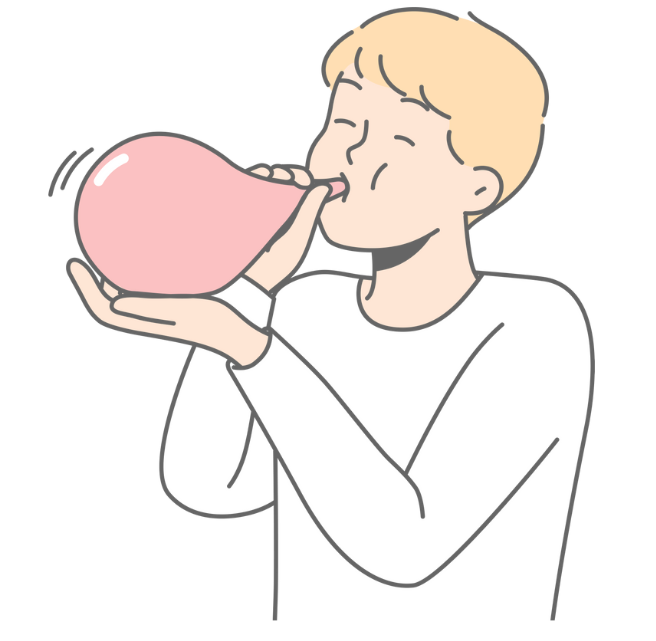
Balloon Breathing How To Guide:
(borrowed from Postural Restoration Institute®)
Start:
Lie on the floor with your knees bent preferably with legs up at a 90 degree angle with feet on a wall or supported over a chair.
Exercise Steps:
Exhale into the balloon…..COMPLETELY.
Why? This is to fully relax the diaphragm and help activate the deep abdominal muscles and pelvic floor
PAUSE, holding your breath out until you start feeling desperate for air and perhaps a little longer.
This is like a diaphragm “reset” - it gives your diaphragm a “rest” break and allows your brain enough time to feel what it is like to relax (the diaphragm). It slows the breathing rate.
Without letting any air from the balloon into your lungs, and without pinching or closing off the balloon opening, INHALE through your nose keeping the balloon in your mouth.
The only way to keep the air in the balloon while keeping the airway open is to actively keep your deep abdominals on and your pelvic floor working in sync with your diaphragm while it contracts. It keeps your lower front ribs down while pushing air into your ribcage in 3 dimensions - especially the back.
REPEAT until the balloon is full.
“Wow, Sarah, my back is more relaxed”
Yes. The diaphragm has a central tendon that connects to the spine. When the diaphragm is always tight and contracted (in a state of inhalation because the person does not fully exhale) the tendon will pull on the spine and arch the spine and cause compression. By exhaling completely as in the above balloon exercise, the diaphragm relaxes and releases the pull on the spine allowing the low back to relax along with it.
“Breathing is the first act of life and the last. Our very life depends on it. Since we cannot live without breathing it is tragically deplorable to contemplate the millions and millions who have never mastered the art of correct breathing.” - Joseph Pilates
****Warning: please do not perform if you have latex allergies, recent abdominal surgery, are post-pardum _____, recent cesarean section, have an uncontrolled rectus diastisis, have extreme urinary incontinence issues, pelvic hernias or recent open heart surgery.
For non-balloon qualifiers: try blowing into your fist, a straw (the narrower the more difficult), or blowing on a windmill. When you get stronger you may graduate to a balloon provided you no longer are dealing with the above conditions.